
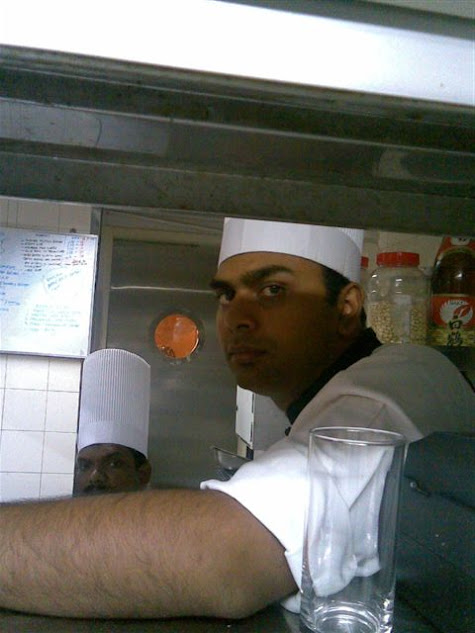
A small note before you begin: This is the first in what I hope will become a quiet running series on Ask Rahul Collective — short notes from a long career in kitchens, and the corporate corridors that followed. Things I learned on stainless steel that I now carry into stand-up meetings, where the only thing on fire is, usually, the deadline.
It was a Saturday night in a fine-dining kitchen on the outskirts of a metro. The kind of Saturday where the bookings sheet looks like a parking-ticket challan from a busy junction. Eighty-seven covers. Two private celebrations. A food critic who had not announced themselves, but whose handwriting on the reservation slip was unmistakable.
And me, in my twenties, standing at The Pass.
For those who have never set foot in a professional kitchen, The Pass is a long, hot, stainless-steel counter. It is the border. Behind it, a dozen cooks are sweating, swearing, and communicating in a private dialect of fire and flour. In front of it, the dining room hums with soft music and well-mannered laughter. And someone — usually the head chef, or that night, very unfortunately, me — stands at this counter and decides what is allowed to cross.
The Pass is not a place. It is a responsibility wearing an apron.
Every dish that goes out first arrives at this counter. The garde-manger places the salad. The grill cook slides over the steak. The pastry team appears, almost magically, with the dessert. And the person at The Pass looks at each plate, wipes a careless smear from the rim, fixes a wilted leaf, sometimes sends the whole thing back, and finally — finally — calls for the runner.
Every plate is a decision. Every decision is public.
Twenty years later, I stood at a different kind of pass.
It was a glass-walled meeting room in a corporate office. I had moved from kitchens into food product development, from product development into innovation leadership, and somewhere along the way the apron had become a lanyard. The plates were now decks. The runners were called account managers. The dining room was now called the market.
But the structure was identical.
Behind me, an exhausted team had built something. In front of me, a room of stakeholders waited to receive it. And I was the one standing at the counter, deciding what was ready to cross.
It struck me, somewhere between the third quarterly review and the fourth client presentation, that almost everything I do now I learned standing at The Pass.
Let me share a few of those things with you.
You are not the cook. You are not the customer. You are the bridge.
The young cook wants to be the hero who plated the dish. The diner believes the chef is cooking only for them. The truth at The Pass is humbler than both. The person at the counter takes credit for nothing and responsibility for everything. They serve neither side. They serve the standard.
In meetings, I have to remind myself of this constantly. I am not there to defend my team’s work blindly. I am not there to please the audience reflexively. I am there to make sure that what crosses the counter is actually ready to be eaten.
It is a strangely lonely position. And a quietly useful one.
Most failures happen in the last six inches.
The dish has been cooked perfectly. The sauce has been reduced for an hour. The garnish has been micro-herbed by people who took their work seriously enough to wear gloves. And then, somewhere in the last six inches between the counter and the runner’s tray, a thumbprint appears on the rim of the plate.
The dish is now ruined.
This is the most painful lesson of The Pass: that excellence is not protected by effort alone. It is protected by attention at the very last moment. Most projects I have seen fail in corporate life did not fail in the work. They failed in the handoff. The deck was brilliant; the email subject line was lazy. The product was ready; the launch communication was rushed. The campaign was sharp; the client was briefed at 11:47 PM.
The last six inches matter more than the first six hours.
Calm is the loudest thing in a busy kitchen.
I once watched a chef de cuisine handle a service that had completely fallen apart. The fish station had run out of butter. The walk-in had failed. A junior cook had cut his thumb badly enough to need stitches. Three tables were waiting on mains.
He did not raise his voice once.
He spoke softer than usual, in fact. He gave one instruction at a time. He thanked people by name when they finished a task. He let the panic happen around him, and he did not catch it.
I have sat through many corporate war rooms since. The leaders I most admire all share this same instinct. When everyone is shouting, they whisper. When everyone is reacting, they pause. When everyone is hurrying, they slow down by half a beat.
It is the most counter-intuitive form of leadership I know. And it is the only one that consistently works.
The plate must look like the menu promised.
A diner orders a “pan-seared seabass with citrus beurre blanc and saffron rice.” If what arrives is a piece of fish on a heap of yellow rice with a vague sauce, the diner is not delighted. They are disappointed — even if the food is delicious. Because the plate did not match the promise.
In corporate life, this is the simplest, most-ignored rule of all. Deliver what you sold. Not more — which feels generous but creates new expectations you cannot sustain. Not less — which feels safe but quietly erodes trust. Match the promise. Every single time.
The team that consistently does this builds a quiet, indestructible reputation. The team that surprises wildly — sometimes upward, sometimes downward — builds an exciting, fragile one. Choose carefully which kind you want to be.
At some point, you have to call ‘send.’
This is the hardest thing about standing at The Pass. There comes a moment when you have looked at the plate, fixed what could be fixed, accepted what cannot, and you must say the word.
Send.
You will never feel completely ready. The seasoning could be checked one more time. The temperature could be a degree warmer. The garnish could be slightly larger. But the table has been waiting eleven minutes. And the sauce is starting to break.
Perfectionism is a luxury The Pass does not afford. Done, served, eaten, judged, learned from — that is the cycle. And the only way to enter the cycle is to call ‘send.’
I find myself saying it under my breath in offices now, when a deck is finished but not perfect, when a launch is ready but not flawless, when a hire is good but not exceptional. Send. Send. Send.
The dining room is waiting.
It has been many years since I last stood at a literal pass. The stainless steel has been replaced by laminate. The runners now have designations. The white jacket has been folded and put away. The tickets are in the cloud, the orders arrive on screens, and somewhere a bot is summarising the meeting we just finished.
Technology has changed. The titles have changed. The titles will keep changing.
But the moment when something built by many people must cross a counter and meet the world?
That counter is still hot. That counter still belongs to someone. And that someone is still you.
If this struck a chord, I would love to hear from you. What is your version of The Pass — the place in your work where every quiet decision suddenly becomes very loud, very fast? Write to me. I read every note.


Leave a Reply